




Articles

Taking the Best Parts of Agile: Part 2 – Connecting with Customers

Connecting with Customers

I had this epiphany when I came to Agile. As a solution architect I had been spending a lot of time getting sign-offs from customers to make sure we had the right solution before we started the project.

The problem is solutions are like art. Often customers don’t know what they want till they see it. Further, they may not even know what the underlying problem is. What they do know, is what is they don’t like what they have today.

While customers are not experts at understanding how to take a problem apart and find an answer, your solution team is, but, your solution team may not know what is most important to the customer. Worse, they often think they know and move forward to test that theory by delivering a finished product – that’s an expensive experiment!

The epiphany I had was: Take the customers who understand where their pain points are and know a good solution when they see it; put them together with teams who are experts at root cause analysis and developing innovative ideas and you create the perfect environment for innovative solutions that meet customer needs.

How to Connect with Customers

Whether you are developing software solutions, creating marketing campaigns, developing education curriculums, or changing a business process, chances are you are trying to think of the right solution for your customers. However, if you have ever delivered a finished project and the customer says “Oh, now I know what I want,” – this is the strong an indication that there’s an opportunity to improve.

Here are some steps to make this actionable:

MOVE FROM DOCUMENTS TO CONVERSATIONS.

Most of what we say is nuanced in inflection and body language. Get a conversation going between teams and customers to better explain what is needed, why, and allow time for questions. It’s even better if teams can watch how people are working today.

BREAK UP THE TIME

Instead of trying to get all the answers at the beginning, provide space to let customers provide an explanation, teams to create a prototype, and customers to provide feedback (made possible by breaking projects into smaller pieces)..

TEST IDEAS WITH REAL CUSTOMERS

Agile teams often create something new and then don’t take the time to get feedback. They’re missing a huge part of the value. The best feedback will come from real customers and you won’t get much value from the opinion of a higher-up – you need to know if the solution makes sense to those who will actually use it in their day-to-day work.

The biggest benefit to getting customers and teams connected is it allows teams to focus on the right problems and quickly test solutions. That means:

As an organization – teams that understand customer needs and spend more time developing customer value. They also waste less time creating low value items, which also means a cleaner product that is easier to support.

As a customer – you get the right solution, the first time, without having to wait for the mythical Phase II. When teams and customers work together, they often provide solutions customers didn’t realize were possible.

As a team – it’s a lot simpler to have a conversation with a customer than to try and guess on a document. It’s also satisfying to see when you hit the mark and have a chance to change it when you miss.

As a project team, it’s your responsibility to figure out where to focus your time. There are elements to any product that customers don’t see that make the end result possible. You don’t need customer feedback on those, but for anything that is customer facing, it’s better idea get feedback from the people who are using it. You may be surprised at what you find.

Next post, we’ll cover Part 3: The Power of Teams.

Taking the Best Parts of Agile: Part 4 – Continual Learning

Continual Learning

It’s cliché that the world is moving quickly. A key element of this change is companies, many whom are your competitors, continually looking for better ways to serve customers. Just ask Sears, Kmart, or Toys R Us and they’ll tell you – If you’re not finding a better way, someone will.

The problem is our current structures are not built for learning – they are built for control. Hierarchies are built to increase efficiency and stability in the organization, not leverage great ideas. We need to change this. We need to build companies of entrepreneurs, where experimentation and innovation are an integral part of what we do. We want good ideas to get the same attention, no matter where they originate.

How to do we foster continual learning into our organizations

Before you even start, one of the first things to consider is understanding what is the clear goal of what you want when you are finished. Do you want more efficiency, do you want more customer value, do you want more sales, do you want more revenue, more profits? As we discussed in Part 3 – Teams are amazing idea engines – set them loose on a problem and they will come up with incredible results, but you have to start with pointing them towards the right problem. As a leadership team – it’s your responsibility to understand where you want innovation in your organization and what is going to make a difference, so your teams can focus on how to get you there.

The next thing you need is the right environment. Looking back again at Part 3 the Power of Teams, we mentioned psychological safety is important. But, that isn’t just safety within the team. Ironically, for the team to succeed they also need to be able to fail. With innovation, people need to feel safe in the organization as a whole, knowing that ideas may not work every time, but when they do, it will be worth it.

You also need an idea meritocracy. Often when you start a new team, members come in wanting to know what their tasks are and when they are due. They know they are usually asked to leave their brain at the door and just do the tasks as asked. What a waste of good people! Teams need to know that great ideas can come from anywhere or anyone. It shouldn’t matter if you are in accounting, you might have a great idea for operations. Operations might have a great idea for sales. You may see great ideas come from facilities, customer service, or accounting. We need to be able to judge ideas on merit, not rank or role.

This next part is a little more controversial since it has to do with money. To entice entrepreneurs, you need to be able to share rewards for great ideas. To find the best way to serve customers, you need to measure the value the team is delivering to them. Taking that one step further – as teams deliver great value, there should be some direct rewards, sharing the value of those ideas that made it possible.

It’s rewarding to see the value customers are getting but if organizations don’t share a portion of the benefits, team members may end up feeling cynical that they’re doing a great job, but the owners are the only ones seeing rewards. Nucor Steal pays employees 75% of market wages, but with bonuses they can make 125%.  At Google, employees can make as much as 300% more than someone in the same role, based on the value of their contributions.  Haier, a Chinese appliance company, has broken departments into small mini companies where employees are encouraged to think of new revenue streams and there can be significant rewards when those ideas payoff.

Beyond the right environment, the last element is room to process and digest thoughts. Agile is the only methodology I’ve seen that does continual improvement effectively. The reason is that there is time built into every iteration to take a step back, discuss where to improve, and build those tasks into the next iteration.  We all know that improvement is important, but we’re not scheduling time to do it.

In one of the departments I managed, I thought I was doing a great job delegating and communicating with my team till we had our first retro. I was surprised to learn that wasn’t the case. Over the course of a year, we were able to eliminate, automate, and delegate my administrative overhead from 20 hours a week to 4. It left me a lot more time to focus on strategic value and the team was much happier with the growth they were seeing. You have opportunities, but you won’t know where those opportunities to grow are, or what is possible, until you take time to ask.

Benefits of Continual Learning

People talk about an Agile transformation like it is a destination that you get to.  However, Agile is a journey. It’s about building an organization that is continually changing and adapting to better fit the world around it. Continual learning is really one of the key principles to Agile because it builds a truly flexible organization.  That means:

As an organization – you don’t have to worry about driving results. A key job today for leadership is to drive the organization to be more effective. Agile puts in a structure where everyone is focused on being more effective. That means leadership has more time to focus on strategic direction.

As a customer – the company is always growing and adjusting to better fit your needs. Every iteration, they are asking how they can serve you better.

As a team – you get growth. Too many times we think people aren’t satisfied because of money or benefits. But a key reason employees leave a job is because they don’t have an opportunity to grow. Continual learning gives you the opportunity to not just do more, but to be more, increasing the value you add. If you’re with a good company, it also means you get to take the results of some of those ideas home as a well-deserved thank you.

The idea of continual improvement isn’t new. Toyota started quality circles after WWII leading to its popularity in the 1950’s. But, 70 years later, it seems we’re still not doing it well. Most teams meet regularly to discuss status. It’s not hard to add some reflection time to those meetings. You can google fun retrospectives to get some ideas of how to get people thinking more creatively. Whether you borrow the approach from Lean or Agile, building continual improvement will help your company grow.

As we have gone through the four key Agile principles, you’re probably thinking they aren’t new. You’re right, they’re not. Agile is really just a collection of good business practices, and rather than a detailed practice, it’s a combination of good principles that companies should leverage to improve what they do.

As you look at Agile, rather than thinking that’s not for me, or that would never work here, do what Agile did —  Take a bunch of great ideas and make them your own.

Member Spotlight - Salvador Marin, PMP

Salvador Marin is a US Army veteran whose plan initially led him to information technology so he could learn how to create video games, his beginning passion. The demands of his military job, a signal satellite technician who ran equipment forged a different path. Salvador was not trained for it; he went to his unit and the needed role had to be self-taught. It started a lifelong education journey where he became the go to guy. The task uncovered his hidden skills and strengths. Salvador discovered that he was analytical and curious. Creating games led to building his own computer, learning about the circuits and how the electrical components connect. Basically, what makes the game work and why does it work?

Salvador’s employment path began in the private sector began by putting his lessons learned into a college degree which he obtained while working. If you ask Sal who he is, “it's a puzzle solver, he now leads others to the solution.” Salvador is a nerd at heart. His nickname is Data. Star Track followers will remember the character who tends to interpret things literally, the black and white, what is said, rather than what is meant, gray. Today he has learned to ask a series of questions to lead others to solutions instead of providing the answer to help perpetuate learning.

His interest in project management, planning his life rather than stumbling into it, led to an interest in finance. Salvador Marin loves to manage costs and schedules, key in the construction industry. This attention to detail enabled his success. “Who doesn’t know the numbers?”

Salvador’s strong sense of family, raising his children, giving back with the Knights of Columbus and his motto, truth is the truth, he feels will keep him on the correct path. His words resonated with me, “if something is hard, remember someone is always looking up to you and you want them to improve their own situation, so no handups, you can do it if you work to the bone.”

Work serves a purpose; it is all about supporting the family His work ethic has set an example to his siblings as a role model. Sal’s love of video games is still alive, he has turned his passion into quality time with his son.

Salvador Marins next career goal is executive leadership, somehow, I envision his winding road taking him there.

Getting to Know You

Are you engaged with the chapter and attending events? We would like to feature you, highlighting what makes you unique, a recent promotion or how you conquered a challenge. We are looking for Members willing to share their story. 
Please submit your willingness to be interviewed to This email address is being protected from spambots. You need JavaScript enabled to view it.

How to Lead People Through Change – ADKAR® Series Part 4: Knowledge and Ability


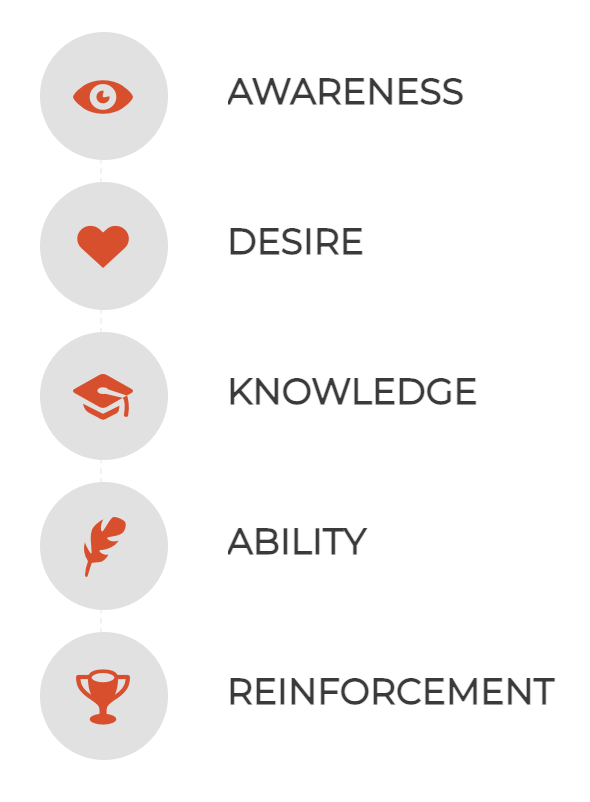
Here is a quick recap of what ADKAR stands for:

·                 

·                 

·                 

·                 

·                 

Knowledge

Knowledge is about each person understanding how to change. This would be the education and training on the new tool, their processes, and them understanding any new expectations – whether it be a new role or new responsibility. Depending on your change initiative this could be as simple as providing a new URL link or as complex as an entirely new office location, reporting structure, and office procedures. But, even with the range of complexity, this ADKAR milestone is where I think, as Project Managers, we are the most familiar and comfortable with as we typically cover aspects of this during our UAT (User Acceptance Testing) and Training sessions.

I have seen some really cool examples when it comes to how to deliver knowledge. Gamification techniques can be used to tap into the reward center of our brains and provide positive reinforcement as a fun and interactive way to help people gain the new knowledge.

I’ve written a blog about using game theory for time-tracking that goes into detail about each game mechanic if you want to learn more about gamification.

There are a lot of additional resources available to help deliver knowledge including creating interactive quizzes, live train-the-trainer sessions, on-demand training videos, and even using a pilot group to help create early adopters or help discover power-users and champions.

Keep in mind, we do not want to take any previous knowledge for granted or make assumptions on their current knowledge level. Sometimes offering a “foundation” class to make sure everyone is on the same baseline of understanding can help before delivering new information.

Ability

Ability is the fourth ADKAR milestone. This is the person’s skills as they relate to the future state. They may have the awareness, they are on board about the change, they have been trained – but do they have the ability? Meaning, do they have the intellectual capability, the physical ability, an SME (Subject Matter Experts) or mentor support, and the time to learn what is needed for the successful change?

One example that helps describe this ADKAR milestone is if there was a change for a company to shift from an hour lunch to a half hour lunch. This may seem like a simple change, but what if the person takes public transport or drops their kids off at school — getting off a half hour earlier or coming in a half hour later is not an option for them.

I think we have all had some personal experience with this when it comes to COVID and having to work remotely. I may be on board to work remote because I understand why (we have a pandemic) I have the desire (I don’t want to get COVID or infect others), I have the knowledge (I have been trained on how to login remote) but do I have good internet and a place to set up my workstation at home?

Also, sometimes it may take people different amounts of time to learn something new. We all know the type of person (I’m one of them) that needs a little bit of time to process and try it on their own to help settle their new understanding of the process. They have gone through training, so they have the knowledge of how to do it, but they may need a few weeks of using the new tool in order to develop their competency and ability to actually use it.

Projects that have a quick go-live and do not account for this may can put a person’s Ability milestone at risk so it’s something to keep an eye on while building out your project plans and working with managers.

How to Lead People Through Change – ADKAR® Series Part 3: Desire

Today, our focus is on the second milestone – Desire in the ADKAR acronymAs you just read in our last blog ADKAR stands for

·                 

·                 

·                 

·                 

·                 

Desire

A person needs to have the desire to participate and support the change. This is a biggie. Without this you may have delays, productivity may decline, and people may even leave the organization. It is also a very personal thing, (as much as we wish we could!) we do not control other people’s choices.

Hiatt mentions there are Four Factors that contribute to an individual’s desire to change:

Is this change an opportunity or threat and what is their WIIFM (What’s In It For Me?)

The Success (or non-successes) of past changes, other changes that may be also occurring in the organization, and the organization’s culture of change.

Our career aspirations, financial security, age/healthy, personal relationships in and out of work

What we value, our internal voice or internal compass.

We talked about Awareness in our last post and desire tends to immediately follow that. We’ve all been there – your sponsor announces, “A Change is Coming!!” and as soon as we log-off the meeting invite, most of us are sending a ping to our manager, “Hey, just heard the news does this mean I have to (insert how I perceived the change will affect me here).”

Because of this common reflex Prosci recommends that the desire messaging is best communicated by the Direct Manager. They are closer to their staff and their everyday duties, so they can help them understand the specific WIIFM.

“As you have heard, we are getting a new PPM tool, this is really going to help you save time when you submit your project status reports because it has a one-click button that aggregates all the data. No more late Friday emails asking where your status reports are! We’ll all be able to log-off in time to attend the company Happy Hour.”

Of course, it is worth noting that the manager needs to have gone through their own ADKAR journey before they can properly help their staff consume the information. If they are just finding out about the change at the same time as their staff, then this is a recipe for disaster.

As change practitioners, we need to help the manager by first getting them through their own ADKAR journey and then preparing them, and giving room for them, to lead their staff through the change. They will need our support to identify and manage resistance and how to provide clear communications on the benefits of the change initiative.

How to Lead People Through Change – ADKAR® Series Part 5: Reinforcement

Here is a quick recap of what ADKAR stands for:

·                 

·                 

·                 

·                 

·                 

Reinforcement

Reinforcement is the person continuing and sustaining the change. During this phase you continue to manage resistance, implement corrective actions, and celebrate success.

It is also important to collect and analyze feedback because creating a good feedback loop, where people have a voice on what is working well and can provide areas of improvement, will help them feel empowered to continue to support the change.

I’ve seen some great success with this when companies have communication channels where employees can recognize other team members that are doing well with the change. Managers have different options to honor them with some type of formal reward including becoming certified or even gaining a promotion. At one company I was at, they called this acknowledgement “Find the Good and Praise It” (FTFAPI) and at another it was known as giving someone a “High-Five.” Both were easy actions for a person to submit a praise and that praise to be shared company-wide.

Unfortunately, try as we might to get people through their ADKAR journeys, some changes may result in employee turnover. Monitoring this effectively can help shape how the organization approaches change and strengthen the culture (or weaken if it is not properly dealt with). This goes back to the Desire blog where we mentioned the organizational or environmental context factors can affect the desire ADKAR milestone based on the success (or non-successes) of past changes, other changes that may be also occurring in the organization, and the organization’s culture of change.

Yes, change is a cyclical journey, and everyone will go through each milestone with each change they encounter. It’s up to us as change practitioners (or project managers with our change management hat on) to help educate our Sponsors, Mid-Line managers, and Team Members on how to effectively manage through each milestone by educating them that this is a process, but we have the resources available to help them through it.

How to Lead People Through Change – ADKAR® Series Part 2: Awareness

Awareness

In order to get people’s buy-in on the change they must first understand the why. Awareness is all about helping people understanding the “Why” of the change.

It's all about the why

Simon Sinek has a book and TED Talk called “Start with the Why” – How Great Leaders Inspire Everyone to Take Action. He bolds the fact that when you communicate the why (the purpose, the  reason) rather than starting with the what (benefits/features) then we are focusing on the part of the brain that controls decision making. Nearing in on the “gut-feeling” part that we tend to draw on when we are making a decision, and our emotional reaction to it.

According to Prosci, this message is best communicated by a trusted, visible, and active Sponsor within the organization and this makes perfect sense. As Project Managers, we are often leading the team on some pretty cool initiatives, but it’s when the CEO takes center stage at a town-hall and speaks to the heart about Why they are going in that direction, that people take notice and listen.

I’ve seen some great examples of how to generate buzz around a new application that was being rolled out. It started with a very friendly message “have you heard the word” that started to gain everyone’s interest and excitement for what may be coming. One company I worked with, had a great idea for a Sponsor Roadshow where the team got a little cart and went around the office handing out ice-cream as the Project Sponsor walked around and started planting the seed about a new department the organization was developing and the benefits it could offer to the organization.

When we do not communicate the why, people will fill in the knowledge gaps themselves. The rumor-mill can be strong, so we want to own the message from the beginning by communicating the Why early on.

2021 Jobs Report - Finding New Footing: Uncertainty abounds, but opportunities are still out there

2021 JOBS REPORT an excerpt from the January issue of PM Network.

BY A. WILKINSON


img

Subway station in New York, New York, USA

imgUnited States

The Outlook: The United States logged the worst economic contraction in its history during the second quarter of 2020, as non-farm payrolls—which account for 80 percent of workers in the economy—dropped by nearly 21 million in April. But by the end of the year, the data was hinting at hope: Hiring during October outpaced September by 15.5 percent, according to LinkedIn’s November Workforce Report. That’s still 5.8 percent lower than October 2019 but reason to celebrate for those on the job market.

But the road ahead for the U.S. job market is murky. “Without adequate fiscal stimulus and safety from the virus, employers and consumers will be unable to move forward, and so the recession will deepen,” says Erica Groshen, PhD, senior economic adviser, Cornell University, New York, New York, USA.

img

—Erica Groshen, PhD, Cornell University, New York, New York, USA

Job opportunities are hardest to find in industries such as recreation and travel (down 41 percent in October compared with the year prior, according to LinkedIn), the arts (down 32 percent), energy and mining (down 32 percent), legal (down 18 percent), hardware and networking (down 14 percent) and entertainment (down 13 percent).

“But as the pandemic persists, we’re beginning to see layoffs occur outside these industries,” says John Challenger, CEO of outplacement firm Challenger, Gray & Christmas, Chicago, Illinois, USA.

Expansion plans have widely been abandoned until companies can emerge from the fog of uncertainty and more clearly define the long-term structural changes that will occur as a result of the pandemic, Groshen says. Companies will hoard cash and delay investment in R&D and capital improvement projects until they can regain certainty around the competitive landscape and consumer behavior.

The Opportunity: Manufacturing, transportation and logistics, construction, retail and real estate have seen the biggest recovery in open positions since hitting lows in April 2020, according to LinkedIn. And while brick-and-mortar retail may be floundering, companies that sell goods and services are strengthening their online infrastructure and offerings in response to the mass shift in consumer behavior, says Challenger. Those organizations will need digital-savvy project talent to push forward.

Project activity—and a need for project managers—extends beyond those fields. When the pandemic first hit, industries that could transition to remote work—largely white-collar professional jobs—immediately implemented work-from-home policies that became long-term for many. By midyear, three-fourths of professional workers, including project managers, were still working remotely, says Challenger.

While CEOs in North America are the least likely to view low-density workplaces as a lasting change (as much as 20 percentage points less than CEOs in Latin America, for instance), nearly half believe the trend will be permanent, according to PwC. For this year, the abrupt but enduring acceptance of digital collaboration tools and remote work will continue, predicts McKinsey, which means a serious appetite for project leaders to effectively steer everything from the development of analytical tools to change initiatives around dispersed teams.

img

PHOTO BY ERGIN YALCIN/E+/GETTY IMAGES. OPPOSITE PAGE, PHOTO BY LIANG SEN/XINHUA VIA GETTY IMAGES

United States:
Geotargeting

Location matters—not only in how many positions are available, but also what sectors they’re in. Of the 100 largest U.S. metropolitan areas, Rochester, New York won the top slot for job outlook, according to ManpowerGroup, with 29 percent of organizations signaling they intended to expand headcount in the last three months of 2020. At the other end of the list, Los Angeles, California; New Haven, Connecticut; and Miami, Florida all fell below zero for overall hiring intention. Here are the sectors with the sharpest seasonally adjusted uptick in hiring intention by U.S. region.

img

How to Lead People Through Change – Part 1: Intro to the ADKAR® Series

dae84214 2f94 4233 974f b477c6e33bca

Ah yes, another elusive acronym for us to add to our business vernacular. If you stay with me on the following ADKAR blog series, I promise this acronym will become one of your favorites. Why? Because it is simple to understand and can make a big impact to helping achieve project success.

Before we get into the details of ADKAR, I’d be remiss if I didn’t mention the importance of Organizational Change Management (OCM) and introduce you to the global leader in change management solutions, Prosci ®.

What is Change Management

Prosci® defines change management as the process, tools and techniques to manage the people side of change to achieve the required business outcome. Change management incorporates the organizational tools that can be utilized to help individuals make successful personal transitions resulting in the adoption and realization of change.

That statement of a personal transition is a key part to understanding the methodology of change management. If you think about a project, there may be a significant percentage of the project’s success relying on a person changing how they work. For example, when implementing a new PPM tool, a project manager may need to be change how they track and report their project plan, financials, risk & issues log, etc. If they have been doing the same process in Excel or Microsoft Project, they probably have some sort of an autopilot and learning how to use a new system will be a disturbance to this autopilot. Some people may have a little blip when they come across change, others will have a colossal reaction to this adjustment.

Not to throw another acronym at you, but OCEAN or The Big Five Theory is one that I’ve been interested in lately as it relates to how people emotionally react to and process change, based on their personality. The range where someone falls on each of the Openness, Conscientiousness, Extroversion, Agreeableness, and Neuroticism spectrum could be an important tell of how they react to change.

Change management is getting out in front of this disturbance – anticipating it – and planning to help people successfully journey through their current state to their future state.

Importance of Change Management

Prosci has 20 years of research into Change Management and their surveys have consistently shown that you are 6x  more likely to meet or exceed your objectives when you implement change management. You are also more likely to stay on budget and achieve the results ahead of schedule.

You can learn more about the details and benefits of OCM in Kelly’s blog: Managing Change: Absent Processes Hurting Your Projects Future or check out the recap of our OCM webinar: Change Management Fundamentals.

ADKAR – An Introduction

As mentioned, Prosci is the global leader of management solutions and there are a lot of tools that Prosci has, but the one that I think complements project management the most is ADKAR since it focuses on an individual’s journey.

ADKAR stands for

 
69879d73 8dec 47c8 9f46 0ff17c9de23c

It represents the five elements of change that must be achieved for that change to be a success. There are a lot of ADKAR resources available outside of attending a Prosci training. Jeffrey M. Hiatt wrote ADKAR: A model for change in business, government, and our community. It’s a short, easy read that can be purchased online.

Lien, wrote a great article that describes how to coach individuals through each section of ADKAR in her blog – Coaching Through Change

Over the next few blogs, we’ll take a deeper look into each one of the ADKAR milestones, starting with Part 1 – Awareness

Article Submissions

Wanted creative writers willing to share their expertise. 

Passionate about a topic? Our members have many skills and untapped knowledge. This is a way to give back to our community if public speaking is not your style.

You can now share them with the chapter and earn PDUs for the time spent creating the article. Articles will be featured on the website and in the newsletter.
 
Please submit articles to This email address is being protected from spambots. You need JavaScript enabled to view it.